
The Expo shopping experience
11 April, 2024 in Newsletter
Reflections from a sustainability & startups fan.
Recently I went to a big weekend expo market with over 100 businesses showcasing products - all under the sustainable lifestyles umbrella - including food & beverage, personal health & wellbeing, everyday household products and more.
As someone interested in both sustainability and local startups, I’d already checked out the website listings and was looking forward to being able to buy specific items without needing to order online (couriers are a hassle where I live, also freedom from packaging is always good!)
As a UX professional, I was interested to learn more about the customer journey for sustainability products - and curious to see how UX as an area of expertise might be able to contribute to making the overall experience easier & the transition to sustainable products more achievable for people.
In this article
Below I’ll write up a bit about my experience and offer a few suggestions for folks who might be considering hosting a stall in future, that are hopefully practical within the constraints of this type of event.
Keep in mind that I’m a UX person not a real customer - if you were going to do a proper Customer Experience review, you should be connecting with a real potential or actual customer who isn’t involved in any kind of design for a job, to shadow or interview them.
(If you’re up for it, map out for each type of customer what you think are the steps in their journey with your product - then connect with them to find out how well your thinking matches their reality!)
Starting with the facts - what did I buy?
$10 - 2x fancy peanut butter (would have purchased anyway, saved $4)
$14 - fancy kombucha (didn’t check the label for sugar before buying, so broke my #sugarFree diet, oops. Won’t buy again.)
$12 on a personal care item (an impulse buy, trickier to use than its less eco-friendly equivalent, to be honest not sure that I’ll use it)
$16 on a nice condiment, saved $4 👍
$7 - dishcloth (good to get a new one of an eco brand I already have, saved $2)
$10 - 4x eco-friendly cleaning products (haven’t used these yet but have a stash waiting until current products run out. Saved $5 all up compared to buying online 🙂)
$6 - recovery coffee afterwards.
How was the experience?
With a big crowd and over 100 tightly packed stalls indoors, it was pretty fullon - packed, with heaps going on.
Below is how I’m imagining the show was designed - with more space and less chaos, compared to how it felt - exaggerating but you get the idea!
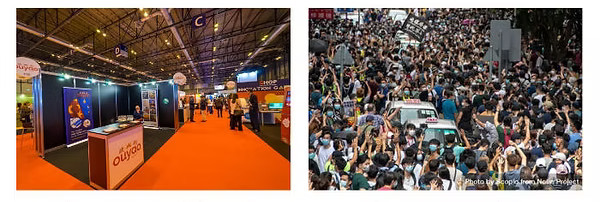
Expo experience as designed vs the experience as felt.
It did feel somewhat incongruous with what you might associate with the sustainability / wellness / Conscious consumer space, but more on this later.
Right hand photo credit: Crowd protesting in Hong Kong by Scopio from Noun Project (CC BY-NC-ND 2.0)
A few stalls that I wanted to check out had queues, so where there was something similar I went to another rather than wait around.
One stall that was popular only had one staff member there, who I felt really sorry for (hopefully there was someone else away on a break?)
I thought some of the stallholders were perhaps finding it all a bit much - several talked at me with a standard "information pitch" rather than having a conversation.
Some things I’d consider if I held a stall at one of these events would be:
- Make the stall signage really clear - your brand isn’t always enough for people passing by to see at a glance what the product is for - if there’s a queue people might pass by rather than wait to learn more.
- When planning, try and visualise what it will be like as one stall amongst many in a busy, loud setting, as this might change how you approach the design (for both customers and staff) and the interactions that you want to have.
- Hire an extra person or two to staff the stall to share the load during busy times, have capacity to connect with more customers, and allow people to take plenty of rest breaks.
The more you already know about the customer journey, including the parts that you don’t see, the more you can tailor the experience to support the best long term outcome.
Breaking down my experience at one stall a bit further, I:
- Noticed a cool looking but new-to-me product so walked up… and was given quite a lot of information
- Bought the most hard-core version (this is the thing that I probably won’t get around to using)
I’m not sure, but curious whether if they’d quizzed me a bit more and suggested starting with the easier version of the product, would I have been more likely to use it and become a repeat customer… ?
What’s a Conscious Consumer and what’s needed to support them?
I suspect that you can’t understand this until ready to become one - and still consider myself very much a beginner!
For a long time, I had no idea that I was spending so much time (including when shopping) rushing about on autopilot rather than really being present. What I found was that there’s a journey towards mindfulness that needs to happen, before being able to consider and then build new habits, including for the everyday things that we do.
For most sustainable or wellness products you need to invest time and attention to learn about them, try things out and build new norms. Often it’s going to take you more ongoing time & effort to use the eco-friendly option especially if you live in a big household.
This can be an uphill battle in a culture where most things are geared to multi-tasking and a fast pace - for example digital products are often designed with the knowledge that “users will scan, not read”. Perhaps this needs to change for the eco consumer?
We know that supermarkets aren’t really designed with the needs of users at the centre. My experience working in UX for large organisations in recent years has been very much one of having to fight for users needs to be prioritised against those of the business, technology and more.
This contrasts with a project further back (around 2010) working in a User Experience Design "dream scenario", where we were well resourced to build and refine a digital platform (and all of the related in-person services & facilities) with the goal of making the user’s experience awesome.
This was a real privilege to work on and I still feel grateful for the experience to remind me of what can be possible. 🌱
Originally published on Medium.